





Imagine standing on the edge of a crater near the lunar south pole, where sunlight barely grazes the rim and water ice hides just beneath the surface. That is the frontier Intuitive Machines is helping to open right now. With a fresh $180.4 million NASA contract in hand and a bold strategic pivot underway, the Houston-based company is no longer just delivering payloads to the Moon. It is positioning itself as the go-to architect of the cislunar economy.
If you follow space stocks or NASA’s Artemis program, you have probably watched LUNR shares swing with each mission update. But 2026 looks different. Intuitive Machines just laid out guidance for $900 million to $1 billion in revenue, a nearly fivefold jump from roughly $210 million in 2025. The question every retail and institutional investor is asking: Can they actually pull it off?
In this deep dive, we break down the catalysts, the risks, and the bigger picture for anyone eyeing LUNR as part of a lunar-economy portfolio.
Intuitive Machines’ Track Record: From First U.S. Commercial Moon Landing to Repeat Success
Intuitive Machines made history in February 2024 when its Nova-C lander, Odysseus, touched down near Malapert A crater. It became the first American commercial spacecraft to land softly on the Moon. The IM-2 mission followed in 2025, delivering science payloads even closer to the south pole despite a tricky tip-over on uneven terrain. Both flights proved the company could handle the harsh lunar environment: extreme cold, low gravity, and communications blackouts.
Now the pipeline is filling fast. IM-3, still using the reliable Nova-C design, is scheduled for launch in the second half of 2026 aboard a SpaceX Falcon 9. Its target? Reiner Gamma, a bright lunar swirl that scientists want to study for clues about the Moon’s magnetic history. These early missions build credibility. They also feed critical data back to NASA, strengthening Intuitive Machines’ hand for larger contracts.
Think of it this way: each successful landing is not just a checkbox. It is proof that Intuitive Machines can execute under pressure, something investors value when billions in future infrastructure contracts hang in the balance.
Becoming a True Space Prime: How the Lanteris Acquisition Changes Everything
Here is the real game-changer for 2026 and beyond. In January 2026, Intuitive Machines closed its $800 million acquisition of Lanteris Space Systems (formerly Maxar Space Systems). The deal brought in-house satellite manufacturing, deep-space navigation expertise, and a proven track record of delivering reliable spacecraft for national-security and commercial customers.
Before Lanteris, Intuitive Machines focused mainly on landers. Now it can offer end-to-end solutions: design, build, launch, land, and operate lunar and cislunar infrastructure. That vertical integration is exactly what turns a “delivery service” into a space prime contractor.
The acquisition also diversifies revenue. Management now breaks down the 2026 mix as roughly 40 percent commercial, 40 percent civil space (NASA and Artemis-related), and 20 percent national security. Recurring services such as the Space Data Network (SDN) for deep-space communications and positioning, navigation, and timing (PNT) become possible. These are higher-margin, sticky revenue streams that Wall Street loves.
The $180.4 Million NASA Win: First Nova-D Mission Unlocks Bigger Payloads
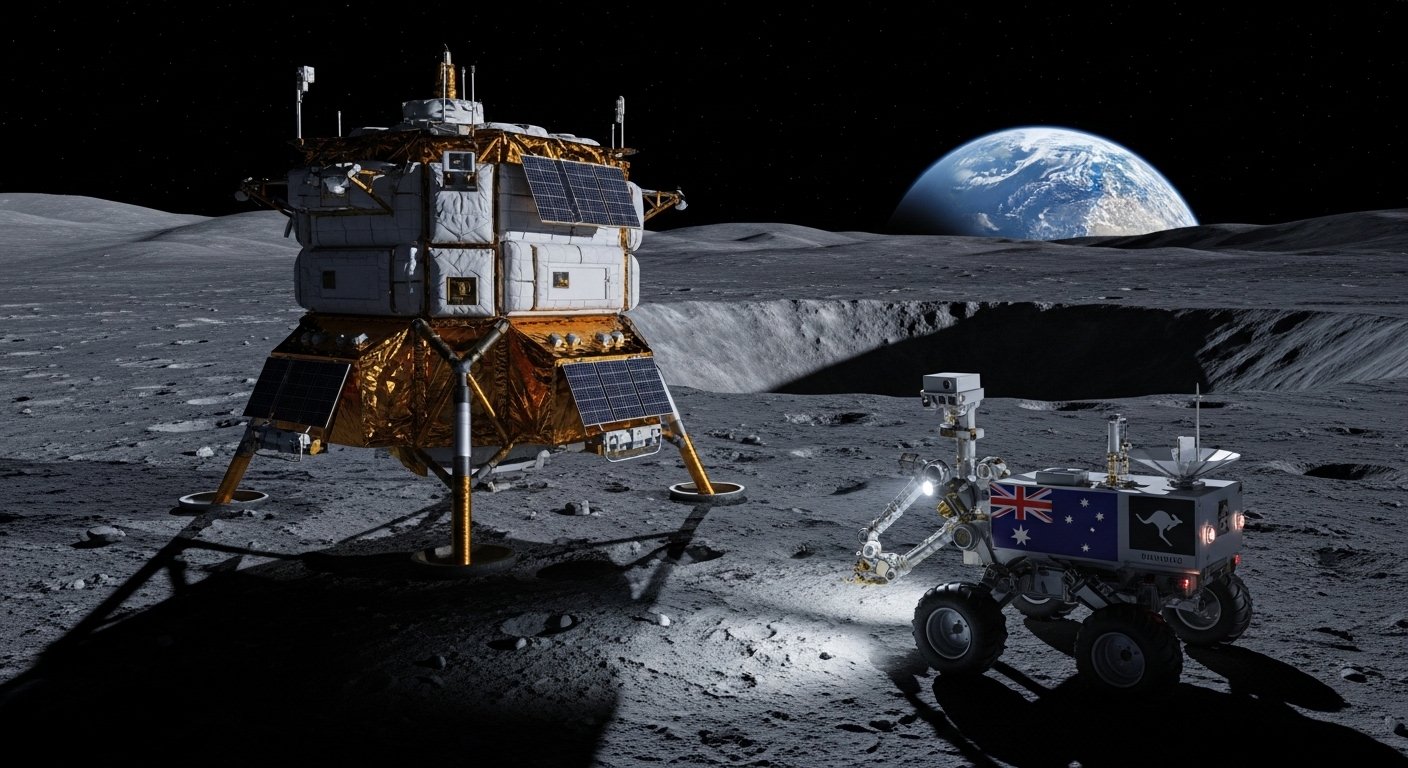
Just days ago, NASA awarded Intuitive Machines its fifth Commercial Lunar Payload Services (CLPS) task order, worth $180.4 million. This one stands out for two reasons. First, it targets Mons Malapert near the lunar south pole, a prime spot for future Artemis bases. Second, it requires the company’s larger Nova-D cargo lander, the first time CLPS has called for this upgraded class.
The mission, dubbed IM-5, will carry seven payloads, including an Australian Space Agency lunar rover and advanced tech from Blue Origin’s Honeybee Robotics. It will study regolith composition, radiation levels, and surface operations, all while demonstrating autonomous surface mobility. Landing is currently targeted around 2030, but the contract revenue starts flowing sooner as development ramps up.
This award validates the Nova-D design and opens the door to even larger commercial payloads in the future. It also ties directly into Artemis goals: sustainable presence at the south pole means reliable power, comms, and navigation. Intuitive Machines is building exactly that infrastructure.
2026 Revenue Catalysts: The Path to $1 Billion
So can Intuitive Machines realistically reach $900 million to $1 billion in 2026 revenue? Management says yes, and the numbers back them up.
- Contracted backlog: Roughly two-thirds of the 2026 target is already locked in at about $943 million. That gives high visibility.
- CLPS momentum: The new $180.4 million award plus existing task orders for IM-3 and IM-4.
- Lanteris synergies: Satellite programs and national-security work start contributing meaningfully this year.
- Commercial upside: Private lunar landers, data services, and cislunar economy plays (think orbital data centers or lunar power relays) are moving from concept to contract.
Here is a quick snapshot of the growth trajectory:
| Year | Revenue (millions) | Key Driver | Adjusted EBITDA Outlook |
|---|---|---|---|
| 2025 | ~$210 | Early CLPS missions + gov delays | Negative |
| 2026 | $900 – $1,000 | Lanteris integration + Nova-D win | Positive |
Analysts have taken notice. Consensus twelve-month price targets sit between $19.94 and $24, with some as high as $26. That implies 15 to 50 percent upside from recent trading levels around $17–20, depending on the day. Of course, these are forward-looking estimates and markets can move fast on mission news or broader space-sector sentiment.
LUNR Stock Outlook: Balancing Excitement with Pragmatism
For retail investors, LUNR offers pure-play exposure to the lunar economy without the bureaucracy of bigger aerospace names. Institutional money is watching too: success on IM-3 and steady progress on the SDN could spark re-rating.
Risks remain real. Lunar landings are hard; even small glitches can delay revenue. Competition from Blue Origin, Astrobotic, and international players is heating up. Execution on the Lanteris integration matters; any hiccups could pressure margins. And broader market volatility (interest rates, defense budgets) can swing the stock.
Still, the forward-looking setup feels different. Positive adjusted EBITDA in 2026 would mark a major milestone. It would show the company can scale while investing in infrastructure that pays off for decades.
Building the Cislunar Economy: Intuitive Machines’ Long Game
Zoom out, and you see why this matters beyond one stock. NASA’s Artemis program aims for a sustained human presence on the Moon. That requires roads, power grids, comms networks, and navigation beacons, all in a place with no atmosphere and extreme temperatures. Intuitive Machines is not just landing robots. It is laying the first bricks of that economy.
Its Space Data Network, powered by Lanteris heritage, could become the lunar equivalent of GPS and internet combined. Commercial customers (mining companies, tourism operators, research labs) will need these services. The cislunar economy, once a sci-fi dream, now has real revenue projections attached.
Key Takeaways for Investors and Space Enthusiasts
- The Lanteris acquisition and Nova-D contract mark Intuitive Machines’ shift from lander specialist to full-spectrum space prime.
- 2026 revenue guidance of up to $1 billion is backed by backlog and diversified contracts.
- Success on IM-3 and IM-5 missions could accelerate commercial deals and Artemis partnerships.
- LUNR remains speculative but carries clear catalysts through the end of the decade.
Next Steps
If you are considering LUNR, start with the latest earnings call transcript and NASA contract announcements. Follow mission updates on the company’s investor site. For aerospace pros, watch how the SDN evolves; that could be the real moat. And for everyone else, keep an eye on the Moon. The next landing could be the one that changes the investment thesis for good.
What do you think: Is the lunar infrastructure boom still undervalued, or are the risks too high? Drop your thoughts below. We would love to hear how you are positioning for the cislunar economy.
You May Also Like: Crafting Your Future: Essential Tips For Effective Estate Planning
FAQs
What is Intuitive Machines’ 2026 revenue guidance?
Management targets $900 million to $1 billion, with roughly two-thirds already in contracted backlog and positive adjusted EBITDA expected.
How does the Lanteris acquisition help Intuitive Machines?
It adds satellite manufacturing and national-security expertise, turning the company into a vertically integrated space prime contractor capable of end-to-end cislunar infrastructure.
When is the next Intuitive Machines lunar mission?
IM-3 is scheduled for the second half of 2026 using the Nova-C lander. The larger Nova-D mission (IM-5) follows later under the new $180.4 million CLPS award.
What payloads will the Nova-D lander carry?
Seven science and technology payloads, including an Australian Space Agency rover and Honeybee Robotics tech from Blue Origin, focused on south-pole regolith and radiation studies.
Is LUNR stock a buy according to analysts?
The consensus rating is Buy, with average price targets around $20 to $24 as of late March 2026.
How does Intuitive Machines support NASA’s Artemis program?
Through CLPS deliveries, south-pole landings, and emerging Space Data Network services that will enable sustained human operations on the Moon.
What risks should investors watch in 2026?
Mission execution delays, integration challenges from the Lanteris deal, and broader space-sector volatility remain the main concerns.


